
Talking in Circles: What It Means and How to Stop Doing It
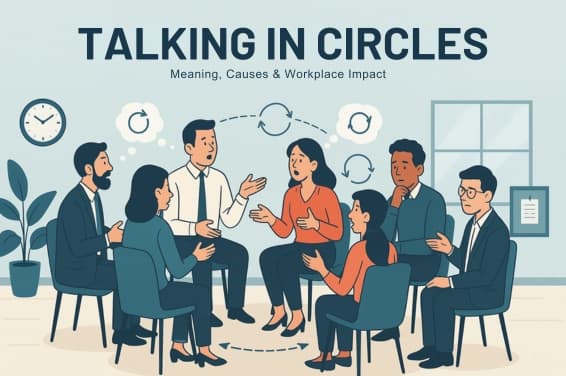
Have you ever left a meeting thinking, "What did we actually decide?"
That's usually what people mean by talking in circles: repeating, rephrasing or revisiting the same points without moving the conversation toward a conclusion. It happens in meetings, disagreements, presentations, interviews and ordinary conversations. Sometimes it comes from nerves or unfinished thinking. Sometimes the person simply hasn't worked out what they want to say yet.
The useful part is that it's a pattern you can learn to spot, in yourself and in a room.
Table of Contents
- What Does Talking in Circles Mean?
- Examples of Talking in Circles
- What Talking in Circles Is Not
- Why People Talk in Circles
- Signs You May Be Doing It
- How It Affects Work
- How to Stop Talking in Circles
- How to Deal With Someone Who Talks in Circles
- A Simple Meeting Framework
- Frequently Asked Questions
What Does Talking in Circles Mean?
Talking in circles means discussing the same point repeatedly without reaching a conclusion, a decision or a new understanding. There are plenty of words, but the conversation doesn't move.
Here's the circular version:
"I'm not saying we shouldn't launch this week. I'm just saying launching this week might not be the best option, although waiting might not be ideal either."
The listener is left asking: so are we launching or not?
And the direct version:
"I recommend delaying the launch by one week because testing isn't finished."
Same position, same uncertainty underneath it, but now there's a destination. That's the real distinction. Talking in circles isn't about speaking for a long time. Someone can talk at length and still be organized and useful. What's missing is progression.
Examples of Talking in Circles
In a meeting. Circular: "We need to decide on the campaign direction, but before we decide we need to understand the direction, and the direction depends on what we decide." Clearer: "We need to pick Campaign A or Campaign B today. I recommend A because it tested better."
Giving feedback. Circular: "The work is good, but it could be better, although I don't mean it isn't good." Clearer: "The concept is strong. Please simplify the headline and shorten the introduction."
Answering a question. Asked whether something can be finished by Friday, the circular answer is: "Friday could work. The issue is that Friday depends on a few things, and those things depend on what happens before Friday." The clearer answer: "Yes, if design is approved by Wednesday. Otherwise Monday."
The second version in each pair gives the listener something they can act on. That's the whole difference.
What Talking in Circles Is Not
Several things get used interchangeably with it and shouldn't be.
Rambling is speaking at length while drifting between points. You can ramble without ever repeating yourself, and you can talk in circles while staying firmly on topic.
Circumlocution is using unnecessarily indirect or wordy language instead of saying something plainly. It's about word choice; talking in circles is about where the conversation goes.
Circular reasoning is a logical fallacy, where an argument uses its own conclusion as support. That's a problem with the structure of an argument, not with how a conversation progresses. The two can happen at once, but they aren't the same thing.
Word salad is worth keeping out of this entirely. It describes severely disorganized or incoherent speech and is sometimes used in clinical contexts. A coworker who over-explains in meetings is not doing that, and borrowing the term makes the comparison both inaccurate and unkind.
Why People Talk in Circles
It's rarely deliberate.
They haven't decided what they think yet. Some people reach their conclusion by talking. That's a legitimate way to think, but in a meeting it leaves everyone else trying to work out where it's heading.
Nerves. Presentations, interviews, difficult conversations, speaking to leadership. People keep re-explaining because they're worried the first explanation didn't land.
Avoiding conflict. A direct answer can feel confrontational. Rather than say "I disagree," someone spends five minutes circling the disagreement without naming it.
Over-explaining. The belief that more background makes the point clearer. Often the opposite happens and the main message disappears underneath the context.
Nobody wants to own the decision. Discussion feels safer than committing, so the team keeps discussing. This one usually looks like a communication problem and is actually an accountability problem.
The meeting has no stated purpose. If nobody knows whether this is a briefing, a brainstorm, a recommendation or a decision, looping is almost guaranteed.
People are waiting to talk rather than listening. The same arguments keep coming back because nobody is responding to what was already said.
Signs You May Be Doing It
- You make the same point several different ways.
- Someone asks, "so what are you recommending?"
- Your answer gets longer each time someone asks you to clarify.
- Meetings reopen decisions everyone thought were settled.
- You finish speaking without a clear request or conclusion.
- People summarize your point differently from what you meant.
- You give a lot of background before stating the main idea.
- You answer a yes-or-no question without ever landing on yes or no.
The quickest self-check: if someone asked you to summarize what you just said in one sentence, could you?
How It Affects Work
On its own it seems harmless. Repeated across a quarter of meetings, it costs real time.
Decisions take longer, and nobody's sure when one was made. People leave the same meeting with different understandings of the outcome, which is worse than leaving with none.
Meetings stretch. When every idea gets explained twice, simple discussions run long. It compounds once several people start restating their own positions.
Ownership stays vague. Teams need to know who is doing what by when. Circular conversations generate discussion without assigning anything.
Misunderstandings multiply. The more indirect the message, the more interpretations it supports.
People disengage. Once a team expects a conversation to repeat itself, attention drops, and then the genuinely important details get missed too.
How to Stop Talking in Circles
The goal isn't to say less. It's to make each part of the conversation move toward understanding or action.
1. Lead with the point. Before the background, say what you want the listener to know. Not "there are several things we've been thinking about regarding the launch," but "I recommend moving the launch to Monday." Then explain why. Point, reason, evidence, next step.
2. Decide what you want from the conversation. Are you informing, asking, recommending, brainstorming or deciding? Those are four different conversations. "I need approval on the final design" opens a much shorter meeting than ten minutes of design history.
3. Cap it at three points. "There are three issues: budget, timing and staffing." Now the listener knows the shape of what's coming and can follow it.
4. Pause instead of filling the silence. A two-second gap feels far longer to the person speaking than to anyone listening. Think, then continue. Pausing also reads as considered rather than uncertain.
5. Summarize before moving on. "So we're launching Monday, Maya finishes testing, and I'll send approval by Thursday." One sentence like that prevents the same meeting happening again next week.
6. Write the decision down. For anything that matters: the decision, the owner, the deadline, and any question still open. A written recap is what turns discussion into accountability.
7. Ask for clarification early. If you're not sure what someone is asking, don't answer the version you assume. "Are you asking whether we can finish by Friday, or whether Friday is the best date to launch?" Clear questions get clear answers.
If you suspect over-explaining is a habit, ask a colleague something specific: "Do I give too much context before getting to the point?" That gets you a usable answer. "Am I a good communicator?" does not.
How to Deal With Someone Who Talks in Circles
Fixing your own habit is straightforward. Handling someone else's takes more care.
Ask for the point directly but neutrally. "What would you recommend?" or "what's the main decision here?" redirects without criticizing.
Summarize back. "Just so I've got it: you're recommending we wait until Monday. Is that right?" Now they can confirm or correct, and the loop closes.
Give the conversation structure. "We have two options. Can we compare them side by side?" Structure gives a conversation somewhere to go.
Separate discussing from deciding. "I think we've covered the arguments. Are we ready to decide?" Especially useful when a topic keeps reopening.
Don't say "you're talking in circles" unless you have to. Even when it's accurate, it lands as an accusation and puts the person on the defensive, which rarely makes them clearer. Redirecting toward clarity works better than labelling how someone talks.
A Simple Meeting Framework
Four parts, and they prevent most circular discussion. They also work as agenda headings.
The question. What are we here to decide? "Which campaign are we launching?"
The options. What realistic choices exist? Campaign A or Campaign B.
The recommendation. What does the owner think? "I recommend A because its test click-through was stronger."
The action. What happens next? "If it's approved today, design delivers final assets Wednesday."
Most looping meetings are missing the first one. If nobody can state the question, the discussion has nowhere to land.
Clear Communication Includes Appreciation
Not every conversation worth having is about solving something. Being clear also applies to telling people when their work helped.
"Thanks for everything" is the appreciation equivalent of talking in circles — pleasant, and impossible to act on or remember. "Thanks for stepping in on yesterday's client call. Your explanation got us to a decision much faster" is specific enough to be believed.
When a few people want to recognize someone together, a thank you card gives everyone one place to add their own line, which beats a scattered thread of messages. The same applies to any office card a team signs.
Frequently Asked Questions About Talking in Circles
What does talking in circles mean?
It means repeatedly discussing or rephrasing the same points without reaching a conclusion, answer or decision. The conversation feels long without having moved.
Why do people talk in circles?
Usually nerves, unfinished thinking, over-explaining, avoiding conflict, poor listening, or reluctance to own a decision. It's rarely intentional.
Is talking in circles the same as circular reasoning?
No. Talking in circles describes a conversation that repeats without progressing. Circular reasoning is a logical fallacy where an argument uses its conclusion as its own support. They can occur together but they're different problems.
Is rambling the same as talking in circles?
Not quite. Rambling is speaking at length while drifting between ideas. Talking in circles is returning to the same ideas without resolving them. You can do either one without the other.
How do I stop talking in circles?
Start with your main point, organize the support into two or three parts, pause instead of filling silence, and end with a conclusion or a next step. Before you speak, ask what you want this person to understand or do once you've finished.
How do I stop a meeting from going in circles?
State the question that needs answering, list the realistic options, ask the owner for a recommendation, make the decision, then record who owns what and by when. If the discussion restarts, summarize what's already agreed before letting it continue.
Speak With a Destination in Mind
Talking in circles happens to nearly everyone sometimes. The problem isn't using too many words. It's using words without giving the conversation somewhere to go.
Start with the point. Add the context that's needed. Ask for or recommend something specific. Finish with the next step. That habit alone makes meetings shorter, feedback easier to act on, and most workplace conversations noticeably more useful.